
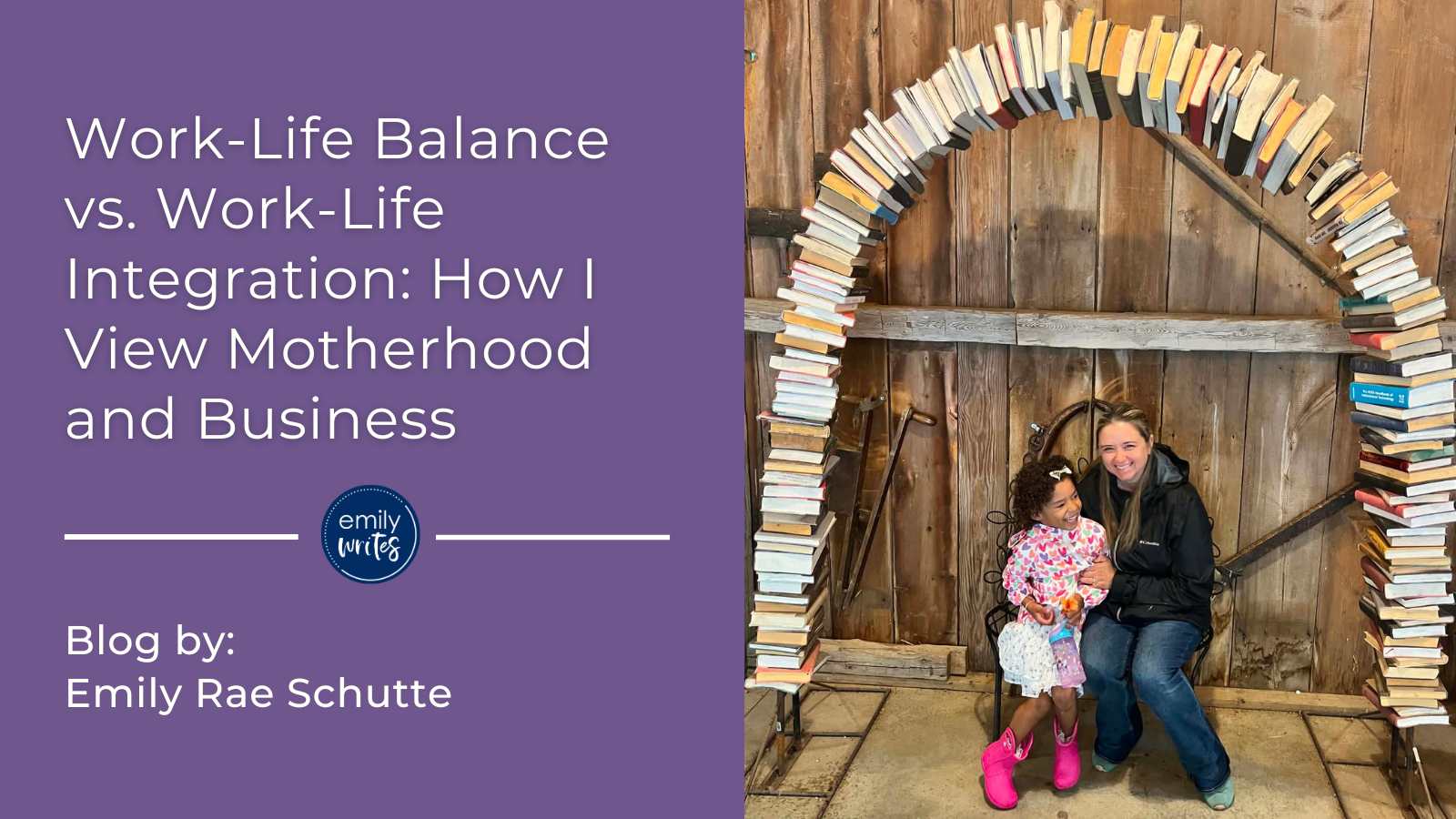
Confession: I’ve spent a lot of hours feeling guilty as a parent and business owner.
Hours wondering “Am I doing enough?” and “Am I doing too much?” Hours worrying that I’m failing in one area or the other (or let’s be honest, both). Hours living with the reality that I’m not giving 100% to either.
It’s exhausting, and I know I’m not alone.
Those feelings of guilt didn’t appear out of nowhere. They grew from trying to succeed in two roles that I absolutely love – but also demand so much from me!
Even if you’re not a parent, I hope you can relate. As you’re growing your business, maybe you’re also trying to work on your marriage, care for your aging parents, volunteer with a passion project, pursue a degree, or simply carve out time for yourself.
Regardless, you can connect with today’s article if you’ve spent far too much energy trying to “do it all.”
Similarities Between Parenting and Entrepreneurship
Sipping my coffee at 5:30 this morning, I spent some time reflecting on the parallels between my self-employment and motherhood journeys.
“The days are long but the years are short” – ever heard that, as a parent? I can easily apply that to the past 7+ years of owning Emily Writes, too. Progress isn’t always visible day to day, but over time, we can really see a huge difference. I hardly recognize the version of myself who said goodbye to her corporate job back in 2019.
“Perfection is a pursuit, not the goal” – still a hard one to hear! Yes, I’m a recovering perfectionist. And unfortunately, there’s no such thing as a flawless parent or business owner. I’m making mistakes and learning as I go.
“Enjoy your season” – the newborn phase was fun, but not for the faint of heart! Four years later, I can hardly remember what it was like to be constantly sleep-deprived. But I’d be lying if I said I didn’t occasionally pull a late night (OK, 9:00 p.m. is late for me!) working on a writing project. Busy and slow seasons are part of the ride.
“It’s OK to ask for help” – whether I was hiring a babysitter or hiring a contractor, both decisions were a game-changer in my overall sanity (and success).
The Case for Work-Life Integration
Have you ever heard or read something and just immediately recognized yourself? When I read Jenna Kutcher’s article, “Screw Balance, This is the New Goal,” I felt so seen!
She argues against the idea of “work-life balance” and encourages “work-life integration” instead. Saying your life is “balanced” implies that everything that’s important is receiving equal time and attention. In reality, that’s unrealistic!
I think social media has convinced women that “balance” means every single day should include productive work, quality family time, a full workout, three healthy meals, eight hours of sleep, and a spotless kitchen. And anyone who doesn’t live up to this must be failing.
Jenna points out that integration is a healthier goal, allowing all the different parts of who we are (parent, professional, spouse, friend, etc.) to coexist, rather than trying to keep them in separate boxes.
I don’t interpret this stance to mean everything is blended, with no boundaries. Having set “on” and “off” times for work is really important for me. But integration means recognizing that every day is going to look different (and embracing that fact!)
Jenna challenges us to stop worrying about giving every part of our lives the exact same amount of time. Instead, we should focus on giving the right things our attention when they need it most, while embracing that our priorities will shift over time.
Some days require more intensive work hours. Last week, I called in two babysitters for two hours each, so that I could meet a couple of work deadlines. And other days allow us to step into our personal lives more fully, like my upcoming 6-day vacation, where I’m intentionally leaving my laptop at home.
Jenna also writes about how she changed her perspective after becoming a parent. Instead of hiding her professional identity from her daughter, she realized that she wanted her daughter to see her working:
“I actually do want her to understand that I work, and even further, I want her to be a part of what I do so that she sees what SHE is capable of doing. If I don’t at least let her see all these other parts of my life, I would be hiding them from her, and giving her only a *part* of me, which isn’t fair to either of us and frankly, so much of her life is made possible through my work. I love my work and I’m proud of it.” (excerpt from here)
While I’m not sure this conversation would be helpful with the average 1- or 2-year-old, kids are pretty darn capable. My daughter is currently 4 (going on 14, I swear!) and she’s been around me working since her birth. I’m her primary caregiver, since my husband works a traditional corporate job and I have the blessing of flexible self-employment.
I wouldn’t call this arrangement easy… but it works for our family. As my daughter has (finally!) transitioned away from afternoon naptime and into quiet time, this summer, she knows she gets one hour to chill in her room, doing whatever quiet activities she wants, while Mom gets one hour to work in her office. She’ll often say “hi” during Zoom meetings and then slip back into her room.
As a mother, I do feel guilty that my attention is sometimes split between my daughter and my business. But she is learning from this upbringing, too. She’s learning that women can build businesses, and that meaningful work takes focus. She’s learning that the world doesn’t revolve around her, because adults have deadlines and other priorities. And she’s also learning that she will always have Mom around.
This highlights another part of work-life integration: Not hiding parts of your identity.
My clients know that I’m a mother – and even if I haven’t spelled it out, I’m pretty sure most of them know that I’m also a work-from-home parent. I work 5-6 hours/week at my church, too, which does an amazing job of supporting all of its part-time employees, including free childcare for the whole staff on Monday mornings during the summer.
These support structures make it easier to flex between work life and home life, helping me find a balanced – oops, integrated – coexistence of the two.
Of course, reading Jenna’s article didn’t magically eliminate my guilt.
I still have days where I wonder if I’m giving enough to my daughter, my clients, my husband, my church, or myself. But it did give me a healthier framework for thinking about those feelings.
Instead of asking, “Did I give 100% to everything today?” I can ask a better question: “Did I give my attention to what mattered most today?” And as I prepare my to-do list for the day or week ahead, I can arrange my schedule to prioritize what matters instead of defaulting to an inflexible number of work hours.
Building an Imperfect Yet Integrated Life
My goal isn’t to have perfectly balanced days. My goal is to build a life where all these disparate pieces fit together – even if they don’t all get equal attention, every day.
I’m done chasing balance. I’d rather pursue a life that feels integrated.
Now it’s your turn! I’d love to hear your story. Have your priorities shifted over the years? How do you navigate the tension between work and the rest of your life? Shoot me a DM on LinkedIn.